

Most teams entering AI search use "citation" and "mention" interchangeably, then build a strategy that wins the wrong one. They are different assets, earned through different content, and they pay out differently. I run an AI SEO agency and this distinction shapes every content plan we write, so here is the full breakdown.
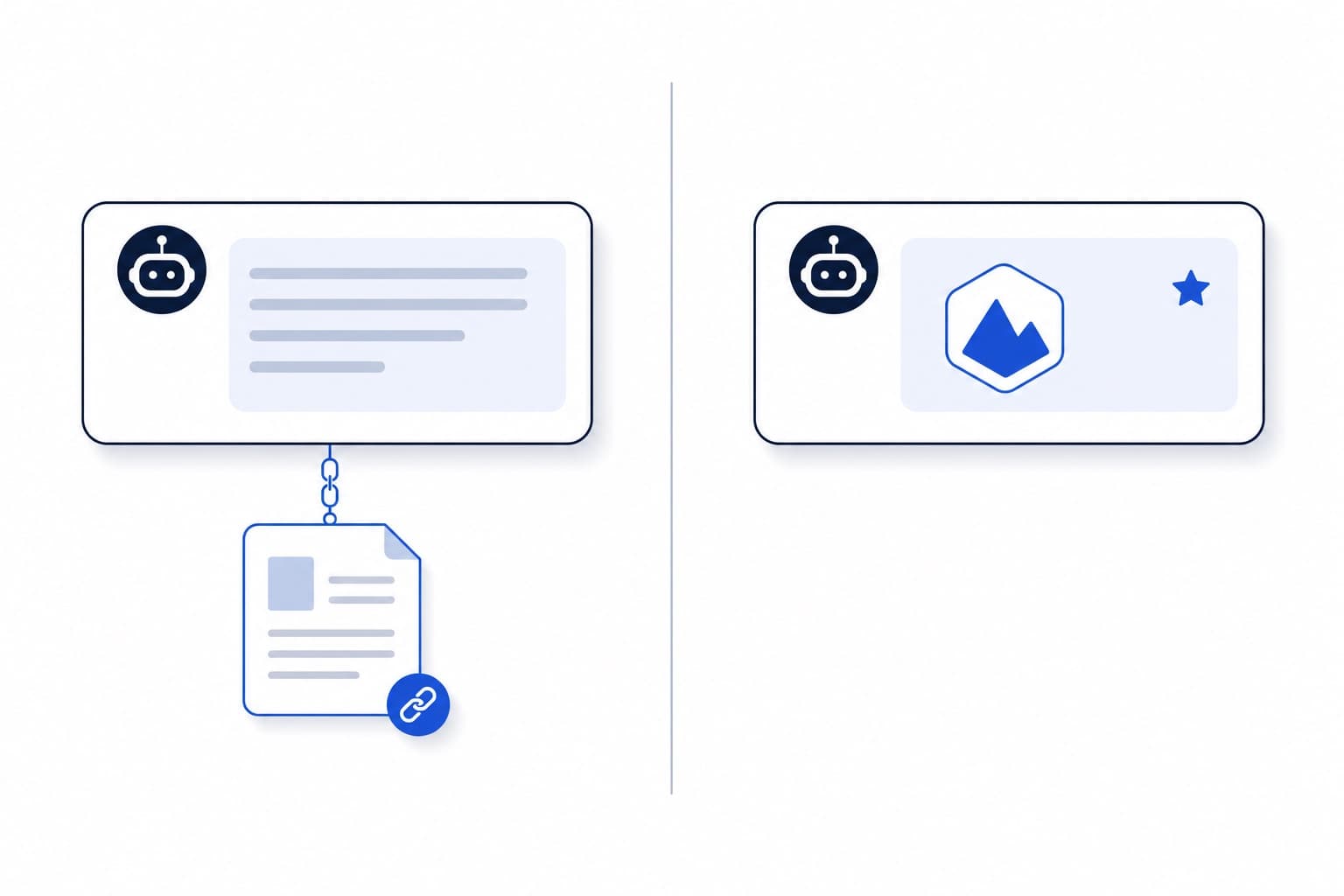
A citation links your page as a source. A mention names your brand in the answer itself.
The definitions, precisely
- An AI citation is your page linked as a source in an AI answer. The engine retrieved your content, parsed it, and used it to compose the response. Citations live mostly in the retrieval layer.
- An AI mention is your brand named in the answer text itself, linked or not. Mentions come largely from what the model has learned about your brand across the entire web, and recommendations are driven by mentions.
The key asymmetry: you can be mentioned without ever being cited. If your brand sits in the right external listicles, comparison posts, and Reddit threads, models recommend you even when your own site never appears as a source. And you can be cited without being mentioned, which is how brands end up donating content to answers that recommend their competitors (Seer Interactive documented pages cited 100+ times with zero brand mentions in those same answers).
If you had to pick one: mentions
A mention is the AI actively naming and recommending your brand at the exact moment someone asks what to buy. That is the commercial event. The data agrees: Ahrefs studied 75,000 brands and found brand web mentions were the single strongest factor correlating with AI visibility (r = 0.664), ahead of everything else they measured, including backlinks and branded search volume.
The good news is you do not have to pick. The point of separating the two concepts is that each has its own playbook, and the playbooks compound.
What citations are actually for
Citations matter for three reasons that have nothing to do with the click:
- Influence over the answer. Cited content is injected into the model's context and parsed. What your page says subtly shapes what the AI Overview or chat response says about your category.
- Backlinks on autopilot. Citations surface your page to writers, journalists, and copywriters researching the topic. They reference you in their own articles, which lifts your domain rating and snowballs into more coverage, and those new third-party pieces become tomorrow's mentions in training data.
- Full-funnel reach. Citations happen on top-of-funnel questions and bottom-of-funnel comparisons alike, anywhere the engine needs evidence.
The content that wins citations is structured and evidence-heavy: original data, studies, statistics with context, deep research, and clearly organized pages a parser can lift cleanly. Listicles also get cited surprisingly often for targeted prompts, which becomes important in a moment.
What mentions are actually for
Mentions are how you get recommended, and they are won mostly at the bottom of the funnel:
- Listicles are the meta. "Best X for Y" and "top tools for Z" content, on your site and especially on other people's.
- Comparison and alternatives content. "X vs Y" and "X alternatives" pages map exactly to the prompts buyers ask.
- External in-niche listicles are the holy grail. A roundup on someone else's site that already gets mentioned by AI engines, with your brand in it, is the highest-leverage placement in this entire discipline.
- Reddit for bottom-of-funnel keywords. Threads asking for recommendations in your category feed both retrieval and training data.
One nuance on funnel stage: by default you get mentioned in bottom-of-funnel answers, because that is where brand recommendations belong. But if your AI search presence is genuinely strong, you start getting named in top-of-funnel and even problem-aware answers too, which is when the channel really compounds.
Why listicles are the meta right now
Listicles sit at the intersection of both assets. They are structured, scannable, and easy for a model to parse, so they get cited for targeted bottom-of-funnel prompts. And they are exactly the information a model needs when composing a recommendation, so they drive mentions. A ranked list makes the model's job trivially easy, and models reward content that makes their job easy. That is why our content plans for clients are heavy on comparison and list formats, on the client's site and placed across the niche.
The combined playbook
- Audit both numbers separately. Run your buying prompts and log who gets cited and who gets mentioned. They will not be the same list.
- For citations: publish structured, evidence-backed content (data, studies, numbers) and listicles for targeted prompts, across the funnel.
- For mentions: build bottom-of-funnel comparison and alternatives content, and earn placements in the external listicles and Reddit threads AI already trusts in your niche.
- Let them feed each other. Citations earn backlinks and writer attention, which produce third-party mentions, which train the next model to recommend you.
- Track monthly. Most AI visibility tools now separate the two metrics. Watch both, weight mentions.
For the broader strategy this sits inside, read GEO vs SEO or the ChatGPT ranking playbook. And if you want to know your own citation and mention numbers, that is literally the first thing our free AI SEO audit measures.

Written by
Gonçalo Canhoto
Founder of RankCite. I help B2B companies get clients from AI search: ChatGPT, Perplexity, Claude, and Gemini. My work includes taking a client to $100,800 in 27 days by ranking #1 on ChatGPT and growing a fintech from $300k to $5M in monthly revenue with AI search as the channel. I publish what I learn, including the parts that did not work.
Watch my breakdowns on YouTube