

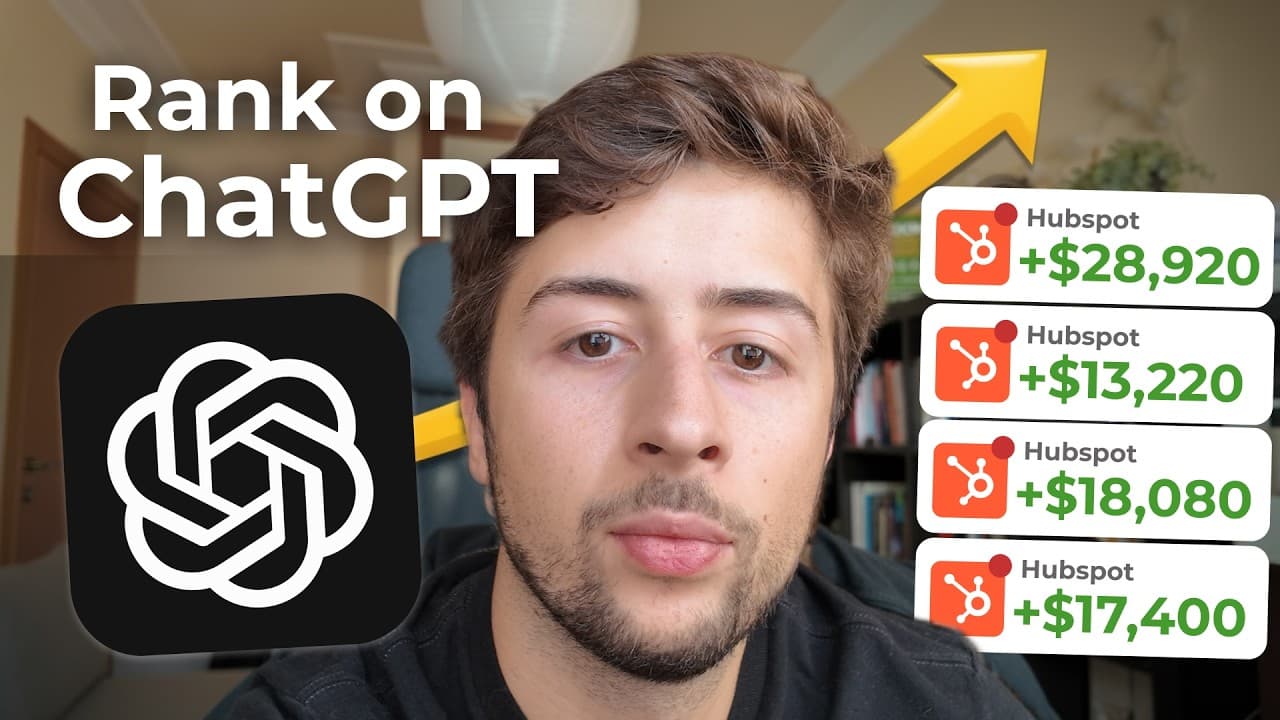
"Ranking" on ChatGPT does not mean a position on a page. It means that when a buyer asks for recommendations in your category, ChatGPT names your brand, describes it accurately, and ideally links to you. We used this playbook to help a client generate $100,800 in 27 days from ChatGPT recommendations, and a fintech grow from $300k to $5M in monthly revenue. Here is how it works.
How ChatGPT decides what to recommend
ChatGPT answers from two layers. The first is training knowledge: the patterns it learned about brands from the public web. The second is live retrieval: when browsing is active, it searches the web and quotes the pages it finds most useful. To rank consistently you need both layers working for you, which is why the steps below split between your own site and the wider web.
The 9 steps
1. Audit what ChatGPT says about you today
Write 20 prompts your buyers would actually ask ("best X for Y", "X vs Z", "top X tools 2026") and run them. Log every brand mentioned, in what order, and how you are described. This is your baseline, and it usually surprises people.
2. Win the queries with buying intent first
Do not try to rank for everything. List the 10 prompts most likely to precede a purchase in your category and focus the next eight steps on them. Citation share on ten buying queries beats vague presence on a hundred.
3. Answer the question in the first 100 words
For each target query, your relevant page should state the answer plainly at the top: what you do, for whom, and why you are credible, in language a model can lift verbatim. Marketing copy that circles the point for three paragraphs never gets quoted.
4. Make every claim verifiable
Models prefer sources whose claims check out elsewhere. Specific numbers with context ("+622% organic clicks in 90 days") beat superlatives ("industry-leading results"). If a claim appears only on your site and nowhere else, it carries little weight.
5. Add schema markup that names your entity
Organization, Service, Product, and FAQ schema help models connect your brand to your category without guessing. It is cheap, fast, and most competitors still skip it.
6. Get into the comparison content ChatGPT cites
Run your target prompts and note which third-party pages get cited: usually a handful of "best X" listicles, review platforms, and industry publications per category. Being accurately listed in those specific sources moves the needle more than any other off-site action.
7. Fix inconsistent descriptions across the web
If your site says you are an "AI visibility platform", your LinkedIn says "marketing agency", and a directory says "SEO consultancy", the model hedges and cites someone clearer instead. Align your description everywhere it appears.
8. Publish genuinely useful category content
Comparison pages, honest pricing explanations, and how-to content give engines more retrievable surfaces where your brand is the natural answer. This compounds: every strong page is another chance to be the citation.
9. Track citations monthly and iterate
Re-run your prompt set monthly (or use one of the AI visibility tools we reviewed) and watch mention frequency, ordering, and sentiment. Double down where you gained, investigate where you lost.
How long does it take?
Retrieval-layer wins (ChatGPT citing your live pages) typically show in 4 to 8 weeks. Training-layer wins build over model release cycles, which is the strongest argument for starting now: the citations you earn today become the pattern the next model version learns.
Do it yourself or get help
Everything above is doable in-house if your team has the bandwidth. If you would rather compress the timeline, this playbook is exactly what our AI SEO service runs end to end, starting with a free audit of what ChatGPT, Claude, Perplexity, and Gemini currently say about you. For the strategic background, read AEO vs SEO and GEO vs SEO.

Written by
Gonçalo Canhoto
Founder of RankCite. I help B2B companies get clients from AI search: ChatGPT, Perplexity, Claude, and Gemini. My work includes taking a client to $100,800 in 27 days by ranking #1 on ChatGPT and growing a fintech from $300k to $5M in monthly revenue with AI search as the channel. I publish what I learn, including the parts that did not work.
Watch my breakdowns on YouTube